Wednesday, 14 September 2016

Uber's Self-Driving Taxi: Today Pittsburgh, Tomorrow The World


Now the videos are starting to flow as Uber's flashy self-driving taxi has officially hit the streets of Pittsburgh Pennsylvania. And in a fell swoop, Uber has up-ended its original business model, thus pushing out the very drivers whose human-operated vehicles made the whole dream possible. 

Sad isn't it? Rip up the taxi industry by replacing licensed cab-drivers with ordinary people with a vehicle, some time on their hands, and a desire to make ends meet--or at least a few extra bucks--; then cut those people out by replacing them with artificial intelligence. Does the end justify the means? 

This will change everything--and it's what Uber plans to do. It's vision, as I've written before, is to take millions of vehicles off the roads, as well as to prevent human-error deaths. And they'll do this by making their solution so smart, so intuitive, that you'll be replacing the keys to your car for Uber's ultra-cool app. 


Pittsburgh, your Uber taxi is waiting for you.


But what about the millions of jobs lost in the process? What about the dad who can't find a transportation job to save his or his family's life? What about the single mom who was able to pick up some extra grocery money by carting people around her city? What about the millions of people right now relying on transportation to make a good honest living? Nope--no good, not sustainable. 

We are seeing the rise of a major disruption to the transportation industry--a disruption that will impact all of us. 

So when you watch the video of Uber's breakthrough self-driving taxi and you are momentarily swept away by its zeal, its cool, its cute facade, don't be too enthusiastic--this is going to have a massive global impact.


Monday, 12 September 2016

7 Great Workout Regimens For A Better Healthier More Powerful Brain


"Sir, what's your phone number?" I was recently asked when filling out some information.

"Uh . . . um . . . well . . . ah . . ."--pathetic! I couldn't remember it.

Maybe it was the number of number combinations I have in my head, between all my passcodes and email addresses, and home phone and mobile phone and work phone and and and . . .

Or, maybe my brain's just run on autopilot for too long as I've relied on my contact list, my reminders, and calendar alerts. Maybe it's just all this technology that's put my brain to sleep.

Some maintain that the ease of technology frees up more room in your brain for other things; but then many maintain we don't use all of our brain's capacity anyway.

Nevertheless, for those of you who are concerned about your brain, or feel you're not using enough of your brain, or, like me, face embarrassment when you can't remember a phone number or an address, these awesome brain workouts are for you.

1. Learn an instrument: Learning is important for the brain. Many people go to work all day, then come home and veg out in front of the tv or stay plugged into their computers. Learning an instrument will work your brain and body--that hand/eye coordination that is important for brain development.

2. Do some math: Hated math when you were in high school? Tough luck--learn to love it. Doing math will stretch your brain and strengthen your memory.

3. Cook: I enjoy cooking--I'd like to do it more. Cooking stimulates all the senses, which is good for the brain. Anything that requires multiple senses is good. In our technological world, we work largely with our eyes and ears, but not so much taste and scent.

4. Learn a language: Drop $199 for Rosetta Stone or take an extended vacation to a foreign country to learn the language--either way, you'll be using that brain, which is a good thing.

5. Exercise: This is really important for the brain--getting the body moving and releasing all those endorphins into the brain. Check this out for top exercises for strengthening your upper body. I'm always looking for quick workouts, simply because I don't have time to get to a gym, and am into fast-track processes that amplify results. Check out the Muller system of the early 1900s--no seriously, it looks amazing.


Slate Magazine on the Muller Workout


6. Play chess: If you have children, get the chessboard out and teach them to play--you'll love it. If they know how to play, put your darn phone down and face off against them. If you're a lousy chess player, puck up some books on chess and learn.

7. Library membership: You need to get into books to get off the technology and get your brain moving again. Buying books is a good thing, but taking 100 books out of the library is just thrilling--no really. Some memberships allow a 100-book limit--imagine the possibilities! Get your kids into it too and turn them into great readers. Whatever you want to learn, you'll find books on it at the library. Get your kids hooked on it too!

The thread here is to stimulate all the senses of your body, and learn learn learn. Any new learning you can do, do it; any new skill you can pick up, or way to use all the senses, do it. Our technological world is keeping us sedentary and mono-sensory. Doing new things, learning new things, getting back into math, and playing an instrument will stimulate your brain.


Friday, 9 September 2016

The Tesla Store Will Destroy The U.S. Auto Sales Industry Through Disruptive Innovation


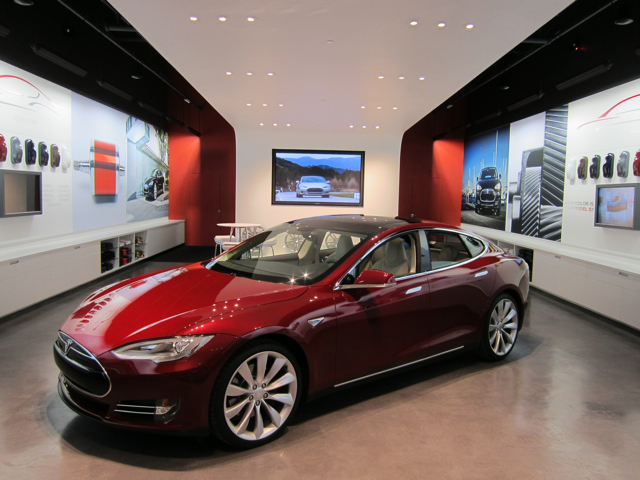
Tesla is rocking another part of the auto industry--sales. Traditionally, and in certain U.S. states, car dealers are critical third parties that mediate auto sales between the manufacturer and the buyer. It is an industry that's been around for decades, and is one of the most deeply rooted financially, corporately, and even politically. But Tesla is changing all that. 

According to the Houston Chronicle, "Tesla Motors won the blessing of the Texas GOP at the party convention in Dallas this month, paving the path towards a possible end to the three years of drama over the electric car manufacturer's right to sell in Texas." It was a long-fought battle; but it appears that the California auto maker will finally be able to sell its vehicles in Texas directly to consumers. This is a monumental victory that will send shockwaves through the Texas auto sales industry--the second largest in N. America. 

The battle wasn't so difficult in the state of Ohio in which Tesla stores have been popping up all over the place, leaving auto dealers outraged. According to the Washington Post, auto dealers have "sued and lobbied their legislators," but the disruptive electric car company is there to stay--the questions is, poses the Post, is the auto sales industry? Ohio's direct auto dealer legislation not only benefits Tesla, but also sets a precedent for traditional auto makers--in fact, it forces them to sell directly just to compete with Tesla's business model. But this casts a brooding gloom over auto dealers, as the Washington Post explains:

[The new legislation in Ohio] has triggered a standoff involving dealers, manufacturers and Tesla over the future of car sales, the role of the Internet and whether it is legal to sell a car — often the second-largest purchase in the lifetime of an average American — online.

This is typically what happens with the victims of disruptive innovation: conform or die. While auto dealers have enjoyed a monopoly on the sales of automobiles for numerous decades, they are now facing obsolescence, and, as such, shaking in their boots. The legislation argument has spread over 20 states in the U.S., most of which have changed their laws to support Tesla's sales model. For those, like Maryland, that have opposed it, Tesla is simply appealing--and, according to Musk, they will continue until they win as they did in Texas over a three year battle. 

Will Tesla upend and destroy the auto sales market as Steve Jobs did the music industry? Some people believe it will not happen--that there are too many points of failure that the auto sales industry has built in to prevent a landslide concession to Tesla. I maintain those who fail to see the collapse of the auto sales industry are delusional. It's already happening; and that's because people are fed up with closed market systems. They want to be able to purchase something right online, without hassle, and have the product delivered right to their front door. Amazon is proving this every day. Consumers do not want to pay extra for vehicles marked up by dealers to make a profit; they want the best price, with freedom of choosing as many options as possible. 

We are seeing another tremendous shift happening. Vehicles are arguably the second largest purchase a person can make; and vehicle sales have been done the same way for generations. Now, with the rise of a renegade tech company that's smart, sophisticated, and tenacious, that system is being taken down and devoured. It is inevitable that Tesla will shift legislation across the United States

And what about Canada? It's been selling cars since 2012 when it opened its first 'store' in Yorkdale Shopping Centre right across, ironically, from the Apple Store. And neither the government nor the auto sales industry in Canada has given Tesla the hassle those south of the border have. Tesla's been selling cars directly, and people have been buying them. Has it radically upended the auto sales industry here? Not really. Many Canadians continue to buy from auto dealers, and aren't outside the dealerships waving banners to free the markets from the auto dealer cartels--at least not yet. 

The U.S., especially Texas, has always had a problem with electric cars. Remember the movie 'Who Killed the Electric Car"? But giving to credit to Elon Musk, Tesla has remained tenacious about its vision to bring a whole new experience to driving, auto sales included. And they will succeed. 

Will the big auto makers be able to shift their operations accordingly? 

We'll see . . . 


Wednesday, 7 September 2016

A Scientist Programs A Machine To Be Your 24/7 Shrink--No Seriously


We live in a disconnected world. While many believe technology is making the world smaller--and indeed it seems to be the case--humans are spending more time communicating through digital media than ever before in history. And in many ways, humans are relying more on their devices for things humans used to do before the advent of the machine, such as checking one's health, being entertained, informing of current events, and even providing customer service. Now with the proliferation of apps, and the rise of artificial intelligence and virtual assistants, we are relying even less on human beings and more on machines--and now machines are moving into the emotional space by providing assistance for people's feelings. 

A New Scientist report explains an app being developed at the University of Aberdeen UK that will assist people through emotional problems, such as stress and depression. According to Professor Judith Masthoff, there is a growing number of people with mental health issues who need informal care. The professionals are only available for the big problems, and thus there is a vacuum of mental health care for people on a daily basis. This app could fill that gap. By creating algorithms that replicate the kinds of therapeutic words one would speak to someone who is suffering, a machine or app could be available at any time for that informal care one would need at any time. So for example, if you were recovering from surgery, and were feeling down, the system would send you a message such as, "I know it's really hard, but you're doing a good job." 

The strange thing is that people at first find it disagreeable to be emotionally supported by a machine algorithm, but the researchers at Aberdeen maintain that once the machine is built, people actually resonate with it. It's no different, they claim, than having a virtual assistant supporting you through a quibble with a warranty or building an investment portfolio; it's no different than an app providing reams of health data on your body. 

But isn't it?

What is happening to the human brain, to human consciousness, that it is so open, so able to adapt to machine communication, especially when it comes to emotional support during times of stress? How is it that humans no longer need the eye and body contact that comes with being supported by another human being, but that a simple blip on a screen suffices? How are we changing as a species when machines are able to sooth us when we're down, calm us when we're stressed, and offer a reassuring word when we need it? How is it that a simple algorithm is now ok to fill the void that human interaction in the past could only fill? And is there not something in the back of one's mind that says, "Wait a minute, this message is not coming from some-one, but rather a machine, an algorithm! There is not a person on the other end of that message who loves me, who cares about me, who's thoughtful enough to send me that message at a time when I needed it most--it's a machine!" 

I find this troubling for several reasons. First, where are the humans? Where are we as humans for people who are down, stressed, recovering from injury? Where are we? And why are we not available for others? Second, why is a message from a machine good enough for us? Are humans not something special, something unique, something greater than the mere sum of its parts? Why are we expecting so little from others that our mere mobile devices will suffice? Third, where are we in our use of technology to accept or be at the place in which we can respond to a message from a computer and translate it into something that reassures us, that touches our soul? And last, where is this all going? Will we be walking into robo-shrinks' offices and having a machine scan us and tell us what's going on deep in our psyches? If we continue to think it's ok and good enough for machines to provide us with emotional support, then we will eventually be seeing robo-shrinks. Are we slowly giving up our humanity for a cheap fix, a good-enough-for-now, a quick download that will get us through our days? And what about human relationships? What if your partner doesn't 'get' you like your machine does? What then? 

It scrambles the mind. It seems to me that indeed, the more computer scientists try to help people through their technology, the more they alienate them, and the more they alienate them, the more people will need technological solutions. It all becomes a vicious regress to more bizarre forms of technology and human/machine interaction.


Monday, 5 September 2016

Move over R2D2! Holoportation Is Real And Changing The Face Of Humanity


Are we becoming less human? 

Sounds like a silly question, but when you look at how technology is developing, the kinds of things being developed, and where it all seems to be going, you get the sense that being human is on the road to obsolescence. 

Take a story I read about today in Wired Magazine dated April 2016 about the rise of "holoportation"--a terms Microsoft has created for its new hologram solution. As Wired describes, "Holoportation, as the name implies, projects a live hologram of a person into another room, where they can interact with whomever’s present in real time as though they were actually there." And what inspired holoportation? The amount of time researchers had away from family, and the desire to reach out to them in a more effective way than merely Skype or FaceTime: “We have two young children," said Izadi, one of the key researchers of the program, "and there was really this sense of not really being able to communicate as effectively as we would have liked,” Izadi says. “Tools such as video conferencing, phone calls, are just not engaging enough for young children. It’s just not the same as physically being there.” The way Microsoft has developed holoportation is to rig up a room with sophisticated 3D cameras that take images of every angle of the individual and the space he or she is in. Once all the images are captured, the custom software stitches them together into a full 3D image. 


Watch holoportation at work!


As a father, I can only imagine coming home to see my teenagers surrounded by their friends who then holoport themselves away when I enter the room. Very strange. 

But get this: to make the technology ubiquitous, Microsoft claimed all one would need is a VR headset. Well, as I reported last week, Microsoft has hooked up recently with Intel to share their knowledge of how to build virtual reality headsets with other VR companies--a way to make this technology ubiquitous. I also echoed the words of Ray Kurzweil who maintains that VR is key to immortality--yes immortality. Through holoportation, one can see how humans will transport themselves all over the world and even to other worlds.

But there is certainly a difference between encountering a physical person and a hologram. I suppose one could see a technology developed that would trigger sensations in the brain to give one the feeling of being with a physical person while in virtual reality. But, again, is being with a physical person a difference that makes a difference for intimacy and overall human relationship? Is a holographic conversation with my child the same as actually being in the room with him? Is there something important about human connection?  What about when I am sad or hurting? Can a hologram really console me? 


Friday, 2 September 2016

Robots Are About To Infiltrate Retail And It's Going To Change Everything


September might be back to school time, but it's more like back to the future time with two technology introductions this month: 1) France is rolling out the world's first driverless bus, and 2) Lowe's in San Francisco will have a robot rolling through its aisles providing customer service.

First, the first driverless bus launched this weekend in Lyon France. I know that Mercedes launched the concept future-bus a number of weeks ago, which I covered here, but this roll out in Lyon France will be taking passengers. According to The Local of France, the mini bus will accommodate 15 passengers and will drive at a top speed of 20 km/hr. It's a small project with the total drive lasting about 10 minutes around the city of Lyon and consisting of 5 stops. This may not seem like a big deal, but, again, technology builds on itself exponentially. With the advent of the first driverless bus, we are already hurtling toward ubiquity. If you're a bus driver, you should be putting together an exit strategy into another profession. 


The driverless bus launch in France.


The transportation industry is going through a massive change in which a decent honest living driving people around in taxis or buses is giving way to artificial intelligence. But it's not the only industry being impacted by artificial intelligence--the retail industry is being hit this month as well. 

This month, Lowe's stores in San Francisco will be introducing the LoweBot: a customer service agent whose job it is to help people navigate the store and find what they're looking for. Lowe's knows it absolutely disrupting the retail industry with its AI sales rep; in fact, they have their own laboratory of ideas called the Lowe's Innovation Labs in which they've cooked up the LoweBot and other disruptive technologies. This is what progressive companies are doing these days, whether Lowe's or Uber or Tesla: designing disruption. 


Introducing LoweBot


How many people do you know who work retail? It's another way for people to find work and make a living. But once innovations like LoweBot becomes ubiquitous--probably in 5 years--where will retail workers go? When transportation and retail jobs go, what's next? The advertisement for LoweBot says that the AI will help people find items as well as track inventory, which will, apparently, free people in the store up--for what? Cutting wood, filling shelves. We already have automated check-out counters. What next?

These are jobs people take to support themselves and families. As inflation continues to climb, and entry-level jobs are given over to robots, what will happen to those who rely on those jobs to survive?

This is where capitalism and social planning come together and disrupt our world. Do these companies have too much power? Do the visionary CEOs have the right to disrupt industries dumping people out of jobs for machines? And should such events as the launch of driverless buses and robot customer service reps be given so much fanfare?

Not by me they won't.


Wednesday, 31 August 2016

Why Those Who Doubt The Rise Of Autonomous Cars Are Totally Outside of Reality


Self-driving cars is a mucky business. Many, such as Ford and Alphabet (the spin-off of Google) claim that self-driving cars will dramatically cut down on accidents, and yet we've already seen such vehicles getting into accidents, such as Tesla's autopilot going wonky leading to deadly crashes. Nevertheless, many people will be happy to give up the freedom to operate a vehicle in exchange for a zero-accident rate, buy the technology seems from reaching that point. Will it ever reach that point?

Transforming the world never looked so easy. . . 
In a recent interview with MIT Technology Review, Christopher Hart--appointed by President Obama as the Chairman of the US National Transportation Safety Board--claimed that indeed self-driving cars would radically reduce the vehicle accident death rate, with the target of "no deaths whatsoever." However, given the complexity of an AI navigating streets, buildings, pedestrians, and other vehicles, Hart maintains that the points of failure would be too great to rely solely on a computer to drive by itself without human management. However, a human and a machine driving a vehicle together also poses numerous challenges, with demand placed on the the human's ability to work with the machine. Hart states,

The challenge is when you have not-so-complete automation, with still significant human engagement—that's when the complacency becomes an issue.  That's when lack of skills becomes the issue. So our challenge is: how do we handle what is probably going to be a long-term scenario of still some human engagement in this largely automated system?

One thing this seems to suggest is an overhaul of driver training with more attention focused on human/machine interaction, i.e., how to drive a hybrid human/machine vehicle. This learning curve could indeed lead to a higher number of accidents and death, at least at the outset and over period of time until the technology shifts to fully autonomous. 

Hart, however, is too myopic in his view of technology. To me, it is appropriate to be an optimist in technological advancement but a pessimist in its outcomes. As Kurzweil and others maintain, technology advances exponentially as the tools of a previous step-change creates the conditions of a leap in the next one (ever faster computers creating ever fast computers). Hence for Hart to admit that,

I'm not confident that we will ever reach that point. I don’t see the ideal of complete automation coming anytime soon.

means that he is not quite looking at the way technology advances. He may, as many others do, be planning for a hybrid system--human/machine--to remain for a decade or more; but he will be surprised when full automation happens prior to that. 

And while people love the freedom of driving, when automation proves to be safer than human-driven vehicles, then it will be a liability to drive a car on your own, regardless of how you feel about it. And with Tesla and Uber coming out with grand strategies for transforming how society facilitates vehicles, we are going to see autonomous vehicles driving legally sooner than we think. We have already seen one instance in which Google has gone before congress to pass laws that would place less restriction on autonomous vehicles for the purpose of testing them. 

People like Hart, while well-informed and very good at what they do, who fail to understand and appreciate the power of technology will always be caught flat-footed when massive changes hit society hard. Like Kodack being beat out of the photo business by digital media, or record producing companies beat out by iTunes, those who believe that 5 years from now will look pretty much the same as today will be unable to adapt and thus unable to perform their jobs--they will become obsolete by the very technology they underestimate. 


Monday, 29 August 2016

The Power, The Glory, The Guts Of TODAY


"I'm going to do it. . . tomorrow."

If you want to optimize your productivity, if you want to be competent, if you want to do something with your life, if you want to be somebody, then put that worn-out excuse away--banish it from your vocabulary, your will, your life, because it will get you nowhere fast. What you need to begin to think about, meditate on, bend your will toward, embrace like life itself is the power of TODAY.

TODAY--you will do the hard stuff first. Those taxes you have to do, that person you need to call, that contact who wants to collaborate with you on a major project--get on it TODAY.

TODAY--you will start to get stronger, healthier, start that exercise program you always wanted to do; ya, that one you've been telling all your friends about--the friends who know you're full of it because you've been a procrastinator your whole life. You're sick and tired of being sick and tired--start that exercise program TODAY.

TODAY--you're going to call that therapist you've been planning to, because you're tired of the same hangups with you or your relationship--that one that keeps you from fulfilling your potential, from being the person you were created to be. You're going to get on it TODAY.

TODAY--you're going to work on your mindset, the one that keeps you negative and in the dumps all day seeing the glass empty rather than full; the negativity that keeps you from pursuing your passions, from having great relationships, from getting close with your son or daughter or spouse. You're going to read How to Win Friends and Influence Others, or Chicken Soup for the Soul, or any other book you've thought pathetic in the past. You're going to check out Carol Dweck on YouTube and start changing your mindset TODAY.

TODAY--you're going to get that oil change in your car, the one you've wanted to get done for the past 5,000 kilometres but haven't had time to make an appointment for. Instead of worrying about your engine dying or running into problems with the lease on your vehicle, you're going to book that appointment TODAY.

TODAY--you're going to pursue that dream. You don't know how you're going to do it, but you are going to stop putting it off. It might be a song you've got to write down, that movie you've always wanted to produce, that rock album that you've had in your head for the past 5 years, that novel that's been sitting half-completed in your desk drawer for 10 years. You're going to start that dream TODAY.

TODAY--you're going to make resistance your enemy. You're going to look resistance in the eye and see it for the beast it is. You're going to curse it and make war with it--like Stephen Pressfield talks about in The War of Art. Resistance has been kicking your butt around for decades, preventing you from living your true potential, from living your dreams. You're going to put on the war paint, grab your sword, and go to battle TODAY.

TODAY--you're going to tell your spouse, your partner, your son, your daughter that you love them. You're going to praise your partner's cooking, the way he or she does that special thing that you've noticed but let go by without praise. You're going to remain silent no more--you're going to give that special person in your life the praise he or she deserves. You're going to do that TODAY.

TODAY--you're going to turn over that new leaf, start that new life, go on that new adventure; the one you've been telling yourself you would for years but never had the time or guts. You're going to start that new career, launch that new business or product, enter that relationship, reunite with that son or daughter or grandchild or old friend. You're going to do it TODAY.

TODAY is what makes history. 
TODAY is what counts;
TODAY is the true breakfast of champions;
TODAY is where the rubber meets the road;
TODAY is the battlefield Napoleon and Churchill and Patton,
and all the other warriors waged;
TODAY is the difference that makes a difference;
TODAY is the centre stage of dreams;
TODAY is the altar of forgiveness;
TODAY is the start of a new life;
TODAY is the opening ceremony of your Olympic games;
TODAY is John Coltrane's saxophone;
TODAY is Tolstoy's War and Peace;
TODAY is Elon Musk's Tesla and SpaceX;
TODAY is your great novel;
TODAY is your Hallelujah Chorus;
TODAY is your new beginning;
TODAY is your road left travelled;
TODAY is your beat of a different drum.

TODAY--

Don't wait till tomorrow . . . 

Tomorrow never comes.


Friday, 26 August 2016

Uber's Self-Driving Taxi Was Spotted Today And It's A Bigger Deal Than You Think


This is the week of self-driving taxi spotting. In Pittsburgh today, the first Uber self-driving taxi--what appeared to be a Ford Focus--was seen roving along with 'Uber' stamped on the door, and a whack of technology strapped to the roof. It comes quickly on the heels of an announcement by the disruptive tech company last week that it would be releasing a test run of "supervised" self-driving taxis by the end of the month. The car was spotted and tweeted by Helen Rosner, editor of Eater. And drivers are able to ride in this taxi for free.


I find it interesting that Uber has disrupted the taxi industry by putting the power to earn money by driving people around into the hands of the common person, and then is now planning to steal that power away by subjecting the driver to a mere machine 'supervisor'--until of course the technology advances the 'supervisor' into a kind of torpid obsolescence. As well, Uber wants to eventually replace car ownership with self-driving fleets of taxis. This, according to Kalanick will free up road space for more parks and people's time for greater productivity. The one thing it won't do, and we're starting to see this, is provide greater freedom of mobility. 


Uber's Travis Kalanick on TED


You see, the one good thing about having a car is I can get wherever I need to go whenever I need to get there. In an emergency, I have the freedom to get to a hospital. What happens, however, when I don't have a vehicle anymore, but must rely on an application on my phone to dispatch one? What if the app doesn't work? What if I'm outside of range? What if there's a malfunction of the self-driving car and it takes me to the wrong location? 

What seems to be a more attractive 'grand strategy' as it were is Tesla's: You own the vehicle, and earn money on it by joining it up with a fleet that drives people around while you're working, resting, or on holidays. And the money made with the car is put toward the overall cost of owning it. I like this notion very much; I think car ownership is a good thing. See the difference? One optimizes freedom, the other limits it. 

Nevertheless, Uber wasn't the only self-driving taxi to make headlines; the Singapore taxi company nuTonomy (my spell-check ironically just suggested adjusting that word to 'autonomy') seemed to preempt Uber's first spotting by announcing it's operational this week. According to BGR,

nuTonomy announced in a press release that the starting August 25th, users in Singapore would be invited to try the service. The trial will be available in the one-north business district, where the company has been conducting self-driving car tests since April.


The nuTonomy of Singapore


And the company's services are going to be offered for free just as Uber's. 

So we're in the midst of a massive change in transportation. On the one hand seems to be Musk's plan to transform the world through vehicle ownership and on the other companies like Uber and nuTonomy (my spell check just defaulted again to 'au-tonomy') that hold out the promise of putting the means of transportation into the hands of a company. 


Wednesday, 24 August 2016

9 Beginner Tips For Stockpiling Food That Will Prepare You For Disaster


We are living in strange times: earthquakes, floods, and political upheaval. There have been a number of stories in the news this week about governments warning citizens to begin stockpiling food, particularly in Germany. While Canada has yet to receive such a warning, it may be wise to begin a stockpile campaign in your home. Here are some tips, some of which are taken from Sean Broderick's The Ultimate Suburban Survivalist Guide:


1. Store foods you eat: It's not a good to store foods that you and your family will have a hard time eating. And when in an emergency situation, it's not a good time to switch diets to accommodate storable food. If you're living on fast food, and you're interested in storing food, you'll need to change your diet. Also, don't buy survival foods just because they're cheap. You have some time now; store foods that you will actually eat and will give you the energy you need.

2. Start with the essentials: Long-term storage foods that are healthy and store well are: whole grains, rice, and beans (Did you know that beans and rice are considered a perfect protein?) Whole grains and brown rice are packed with nutrients. 

3. Then move to other essentials: Dried and canned vegetables will be important. You'll also need some oils to cook your food in, such as olive, vegetable, and peanut. You can also add some canned or dry meats, fish, and chicken to your stockpile. 

4. Energy foods: Things like peanut butter, dried fruit, and other such snacks are great for instant energy. Chocolate is also a very important item, not only for its health benefits, but also as an item for barter (Chocolate is said to be veering into a shortage). Imagine yourself in some kind of catastrophe (natural disaster for instance), and think about what you'll need to eat to stay energized. There'll be a lot of demand placed on you, so you need to think energy when you're stockpiling food. 

5. Plan: You need to make a list of the foods you eat over a two-week period. Also, you need to know how much food you and your family eat per week. This will help you plan what and how much to buy.

6. Designate Storage Space: The ideal place to store you food is a cool dry area that sustains a temperature of 40 degrees fahrenheit (about 4 degrees celsius). This is difficult, especially for those who have hot summer months. The average is more like 70 degrees fahrenheit (21 degrees celsius). Keep in mind that every 10 degrees above that halves your storage life. You need to find a space that holds that cool dry temperature, and where you can store ample food. A nice dry basement can be a good place to store your food. If your basement is full of stuff, you might need to declutter--a fairly easy task. 

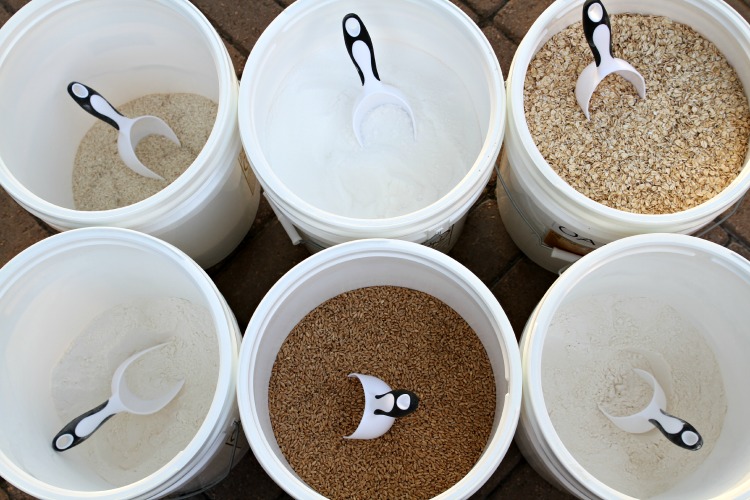
7. Food-grade containers: You need to use food-grade containers to store your food, otherwise it simply won't last. Food-grade containers are simply plastic containers designed to store food. A common container is a plastic bucket with a rubber gasket lid manufactured specifically for storing food. This is an important part of your stockpiling, especially if its grains, rice, and beans. 


8. Price-list: I have a friend who buys multiples of things when they're on sale. Whereas I tend to buy one, grateful for the price reduction, he buys 5-10. This is a good way to save money and stockpile at the same time. This requires that you understand the general price of things you need to stockpile, and their lowest price; and you understand this by putting together a price-list. It's not difficult: a small notebook in which you copy down the foods you want to store, and how much they cost at the various stores you purchase them at, including the lowest price possible. When it comes to stockpiling, you can determine if what you're purchasing is at the lowest price, or will come down further.

9. Keep Inventory: If you stockpile food but forget what you have and when it expires, you could be wasting money and food. When you store your food, keep an inventory list of what you have and when it's likely to expire. Check it routinely. If certain items are nearing expiry, use them. 

Stockpiling food that will last you 10 days is a good place to start. It may seem excessive; it may seem alarmist; but there are enough news reports that suggest it's not a bad time to begin. Take your time, but don't hesitate. Whenever you see something you need on sale, buy 5 of them. Remember, if you go slowly, you won't overwhelm your budget. The important thing is you do it. Just thinking about the Ontario ice storm and the Calgary flood--both in 2013!--is enough to keep us sober-minded and prepared.